
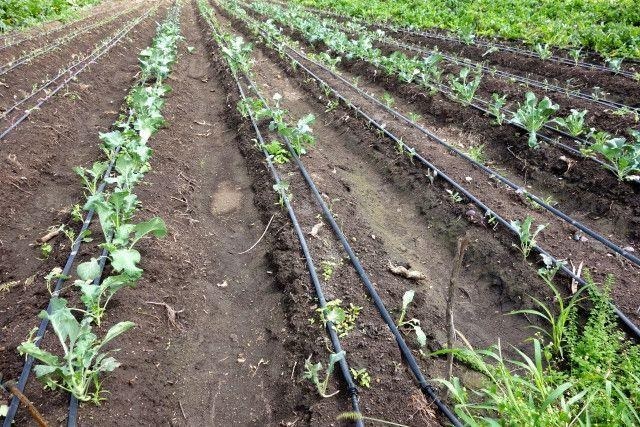
Drip tape and drip line do the same job: they carry water along the crop row and release it at each plant through built-in emitters. They are built for different lives. Tape is a thin-walled, low-pressure product, laid for a season or a few; drip line is a thick-walled pipe with moulded drippers, installed for years. Choosing between them is a question of crop, season length, terrain and how the field is managed, not of which one is "better".
The two products side by side
| Drip tape | Drip line | |
|---|---|---|
| Wall thickness | Thin: 0.15–0.6 mm (6–24 mil) | Thick: 0.6–1.2 mm |
| Shape when empty | Lies flat; rounds out under pressure | Round tube |
| Working pressure | Low: about 0.4–1.2 bar | Higher: about 0.5–3.0 bar; pressure-compensating types up to about 4 bar |
| Emitter spacing | Close: 10–30 cm | Wider range: 20–100 cm |
| Typical life | One season for thin walls; several for thicker walls handled with care | Many seasons |
| Cost | Low per metre, repeated each replacement | Higher per metre, spread over years |
| Typical crops | Vegetables, strawberries, cotton, sugarcane and other seasonal row crops | Orchards, vineyards, greenhouses and permanent or semi-permanent rows |
The ranges above are those of our own drip irrigation tape and drip irrigation tubes; other suppliers' ranges are similar.
Choosing wall thickness for drip tape
- Thin walls (around 6–8 mil) suit a single short season on smooth, well-prepared beds, where the tape is removed and discarded after harvest.
- Medium walls (around 10–15 mil) tolerate longer seasons, rougher handling and some reuse.
- Heavy walls (above 15 mil) suit stony ground, insect or rodent pressure, longer crops and tape buried below the surface.
The cheapest tape per metre is not the cheapest per hectare if it splits in mid-season and the crop goes without water while it is repaired.
When drip line is the better choice
- Permanent crops. Trees and vines need the same line for years.
- Slopes and long runs. Pressure-compensating drippers deliver the same flow at the top and bottom of a slope and along long laterals, where tape would water unevenly.
- Greenhouses. Lines are handled repeatedly between crops, and thick walls survive it.
- Poorer water quality. Moulded drippers with wider turbulent paths tolerate more than the small emitters in thin tape, although both still need filtration.
Spacing and flow: matching the soil
Water spreads sideways further in clay than in sand. Sandy soils need closer emitter spacing, or a higher flow, to form a continuous wetted strip along the row; heavier soils allow wider spacing and lower flows. Match emitter flow to how fast the soil can absorb water: a flow faster than the soil's intake rate forms puddles and runoff instead of a wetted root zone.
Lateral length and the supply network
The maximum length of a lateral depends on its diameter, emitter flow and spacing, the inlet pressure and the slope. Exceed it and the far end of the row receives much less water than the start. Use the manufacturer's length tables for the exact product, and size the sub-main and main pipes for the total flow of all laterals running at once; our PE pipe diameter and pressure guide and how to choose PE irrigation pipe cover that side of the system.
How much lateral a hectare needs
With one lateral per row, the length needed per hectare is 10,000 m² divided by the row spacing in metres. Multiply by the price per metre, then divide by the number of seasons each product will last, to compare tape and line on the same footing.
| Row spacing | Lateral per hectare | Typical crops |
|---|---|---|
| 0.8 m | 12,500 m | Dense vegetable beds |
| 1.0 m | 10,000 m | Vegetables, strawberries |
| 1.5 m | about 6,700 m | Cotton, sugarcane, wide-bed vegetables |
| 3.0 m | about 3,300 m | Vineyards, dense orchards |
| 5.0 m | 2,000 m | Orchards |
Two laterals per bed double the figure. Roll length then decides how many rolls to order and how many joints the installation will need.
Why laterals fail early
- Pressure above the rating. Thin tape splits when a pump starts against closed valves or when the inlet pressure is not regulated. A pressure regulator at each zone costs far less than replacing a field of tape.
- Insects and rodents. Thin walls are chewed; heavier walls or burying the lateral reduce the damage.
- Clogging. Emitters close up when filtration does not match their passages or when fertiliser precipitates in the lines.
- Kinks and crushing. Tape folded sharply at the ends of beds or crushed by machinery stops delivering water beyond the fault.
- Sunlight. Product left on the surface after the season degrades if it is not UV-stabilised.
What to specify on an order
- Diameter and wall thickness
- Emitter spacing and flow rate at the stated pressure
- Pressure-compensating or not, for drip line
- Roll or coil length, which decides handling and the number of joints
- UV stabilisation, for anything left on the surface in sunlight
- Required filtration for the emitter, so the filter can be specified at the same time
Send us your crop, row spacing, row length, water source and whether the field is flat or sloped, and we will recommend tape or line, wall thickness and spacing, and quote the PE pipe for the supply network with it.