
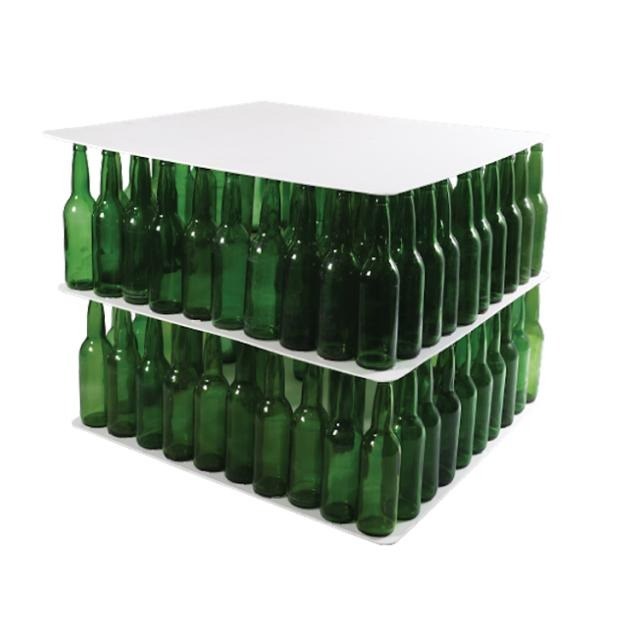
A bottle or can layer pad must fit the loaded pallet and the handling line. Select its outline, flatness, surface and construction using the actual container pattern, equipment clearances and transport duty. There is no universal pallet-edge deduction or grams-per-square-metre rule that establishes safe stack height.
Start with the load pattern and equipment
Send a plan view showing the pallet deck, bottle or can positions, loaded footprint, any overhang and the pad outline. Mark unsupported areas and the contact points between tiers. A pad sized only to the nominal pallet can interfere with guides or leave part of a container base unsupported. Approve the outline against the actual arrangement.
Ask the line operator how pads are picked, transferred, located and removed. Vacuum pickup, clamping and sweeping have different requirements for flat areas, edge grip, sheet stiffness and clearances. A plastic pad is not picked up magnetically merely because a line uses magnets elsewhere. Check the pad-handling mechanism itself.
| Interface | Information to supply | Sample check |
|---|---|---|
| Loaded pallet | Deck drawing, container pattern and contact areas | Support, overhang, alignment and load movement |
| Pickup and transfer | Vacuum or gripper arrangement and cycle conditions | Pickup reliability, separation and positioning |
| Depalletizing | Sweep path, guides, sensor positions and clearances | Snagging, double pickup, sliding and pad removal |
| Return and cleaning | Wash process, drying, storage and reuse conditions | Flatness, retained liquid, wear and cleanliness |
Compare construction using the complete unit load
Specify material, thickness, mass per area, channel direction, surface finish, edge finish and dimensional tolerances. Thickness and grammage describe the sheet; neither independently proves the number of filled tiers it can support. Include the actual container weight, pattern, pallet support, stacking duration, restraint and environmental conditions in the approval plan.
Check compression, sustained deformation, pad slip and transport stability with representative filled containers and the intended restraint. Record whether loads are spread or concentrated and where the lower pallet is supported. A centre-strip bending result cannot establish edge support, the stability of the stack or compatibility with an automatic line.
ISO 12048 describes compression and stacking methods for complete filled transport packages. It does not provide a universal layer-pad capacity. Agree with the test provider whether its scope and an additional unit-load or line trial suit the proposed arrangement, and define the acceptance criteria before testing.
Define friction for each operation
A surface that resists movement during transport may behave differently during a sweeping or sliding operation. State which surfaces touch glass, metal, plastic, the pallet or the handling equipment. Trial the proposed surface with those materials under the expected dry, wet or cleaned conditions. Do not replace a line trial with the words anti-slip or low-friction on a quotation.
Distinguish a layer pad separating tiers from a load-bearing slip sheet used with a push-pull attachment. Their grip tabs, load path and equipment duty differ. Confirm which component is being purchased before comparing prices or asking one sheet to perform both functions.
Specify cleaning, contact and retirement
Agree wash chemicals, concentration, temperature, pressure, exposure time, drying and inspection. Inspect the finished pad after a defined reuse trial for cracks, crushed channels, distortion, contamination and damaged edges. Set repair or retirement limits from its required function; no fixed number of trips proves continued fitness.
For food-contact use, identify the actual contact with food or food-contact surfaces and the intended temperature, duration and reuse conditions. Virgin PP or a resin declaration alone does not establish compliance of the finished pad, colourant, additives, coating and processing. The European Commission's food-contact overview explains the EU framework, plastics measures and compliance documentation. Confirm the current rules and supporting evidence for the destination and exact use.
Keep weight comparisons on the same basis
For an explicitly hypothetical mass calculation, a rectangular 1.20 × 1.00 m pad at an assumed 800 g/m² has a bare mass of 960 g. A 1.19 × 0.99 m pad at the same assumed grammage has a mass of 942.48 g, a difference of 17.52 g. These are arithmetic examples, not recommended sizes or product capacities; cutting, edge sealing and other components can change the finished mass.
Request a layer-pad sample and quotation. Send the pallet and layer drawings, container type and filled mass, stack and handling conditions, equipment interface, cleaning process, intended contact and destination. Include the test and inspection criteria, order quantity and delivery schedule. Review layer pad options before fixing the final specification.