
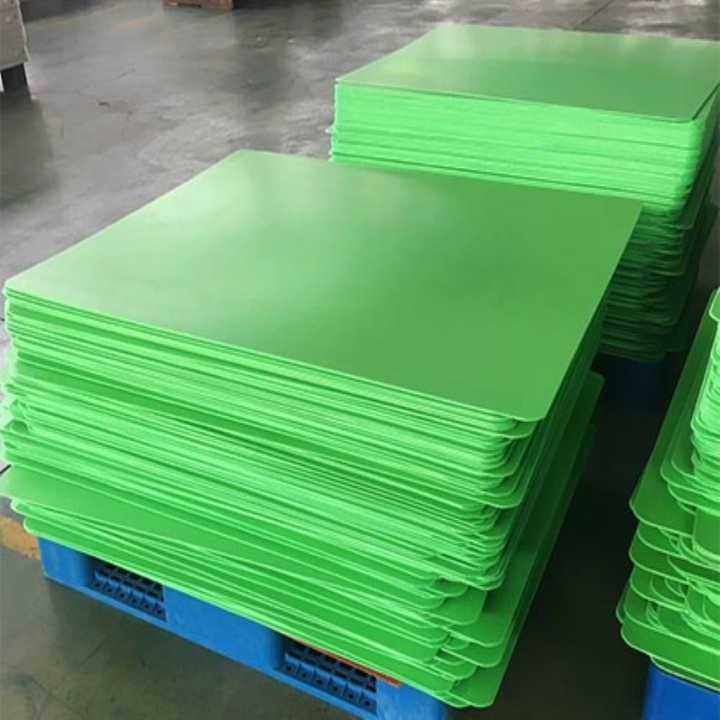
Minimum order quantities on extruded packaging are not negotiating positions. They come from machine setup, and understanding which setup constraint you are hitting is what turns "our MOQ is 3,000 sheets" into a workable conversation.
What sets the minimum on hollow sheet
Three separate constraints, and they bind at different points.
Die width. The extrusion die fixes the sheet width. Producing a non-standard width means changing or adjusting the die, which is hours of downtime. This is why suppliers push hard toward standard widths and why a custom width carries a much higher minimum than a custom length. Length is simply where the cutter fires — it costs nothing.
Colour changeover. Switching colour means purging the extruder. The transitional material is scrap, and the quantity is fixed regardless of your order size — commonly tens to a couple of hundred kilograms depending on line size. On a large run that scrap is a rounding error. On a small run it can exceed the value of your order, which is precisely why custom colours carry high minimums.
Additive changeover. Antistatic, flame-retardant and UV grades each require the same purge logic, and conductive carbon-black material is particularly stubborn to clear from a line. Expect the highest minimums here.
This is why the answer to "can you do 500 sheets?" depends entirely on what you are asking for. Five hundred sheets in a stock colour at a standard width is often possible. Five hundred sheets in a custom colour with FR additive is not, at any price you would want to pay.
How the units differ across products
Quotations become incomparable when the units differ, which happens constantly across a mixed packaging order.
Hollow sheet is quoted per sheet, per square metre, or per kilogram. Per kilogram is the honest unit, because it prices the actual material — a supplier quoting per sheet can quietly reduce GSM and appear cheaper. When comparing, convert everything to price per kilogram and the picture usually changes.
Fabricated boxes are quoted per piece, with the cutting die amortised or charged separately — ask which, because a die charge buried in the unit price makes reordering look artificially expensive later.
PE pipe and drip tape are quoted per metre or per coil, so the minimum is a total length, not a piece count. Layer pads are usually per piece but priced from sheet yield, so pad dimensions that waste sheet area raise the unit price disproportionately. A pad size that nests four-up on a standard sheet costs meaningfully less than one that nests three-up with offcut.
Three ways to reach an economic quantity
Standardise dimensions across products. If you need three pad sizes, check whether two of them can be the same. Consolidating onto fewer sizes multiplies the quantity per specification and often moves you into a better price tier without buying more material overall.
Combine into one production run. Several products sharing the same material specification — same thickness, same GSM, same colour — can often run together, since the setup cost is incurred once. Ask the supplier explicitly whether your items can share a run; they will not usually volunteer it.
Order the annual quantity, take staged delivery. Production runs once, you pay for the material, and delivery is split across the year. You get the volume price without the warehouse problem. Expect to pay a deposit covering the full quantity and to agree a storage arrangement — most suppliers will hold goods for a few months, not indefinitely.
What is not worth doing
Splitting an order across multiple suppliers to stay under each one's minimum. You pay setup costs multiple times, you get material with visible colour and dimensional variation between batches, and you have no supplier with enough of your volume to care when something goes wrong.
Accepting a "special" low MOQ without asking what changed. Sometimes it is genuine — the supplier has stock material or a scheduled run you can join. Sometimes it means off-spec material, a lighter GSM than quoted, or reground content. Ask directly which it is; the answer is usually given straightforwardly.
Buying a year of stock to hit a price break on material that degrades. Corona treatment decays in weeks to months. Additive-based antistatic depletes over 6–18 months. Buying two years of pre-treated printable sheet saves money on paper and produces unprintable material in practice.
Asking the question productively
"What is your MOQ?" gets a defensive number. "We need 800 pieces — which specification changes would bring that within a normal run?" gets an actual answer, often something like: standard width instead of custom, stock blue instead of matched colour, and it fits.
Send us your item list with dimensions, quantities and timing, and we will tell you which lines are the binding constraint and what the realistic minimum is for each.