
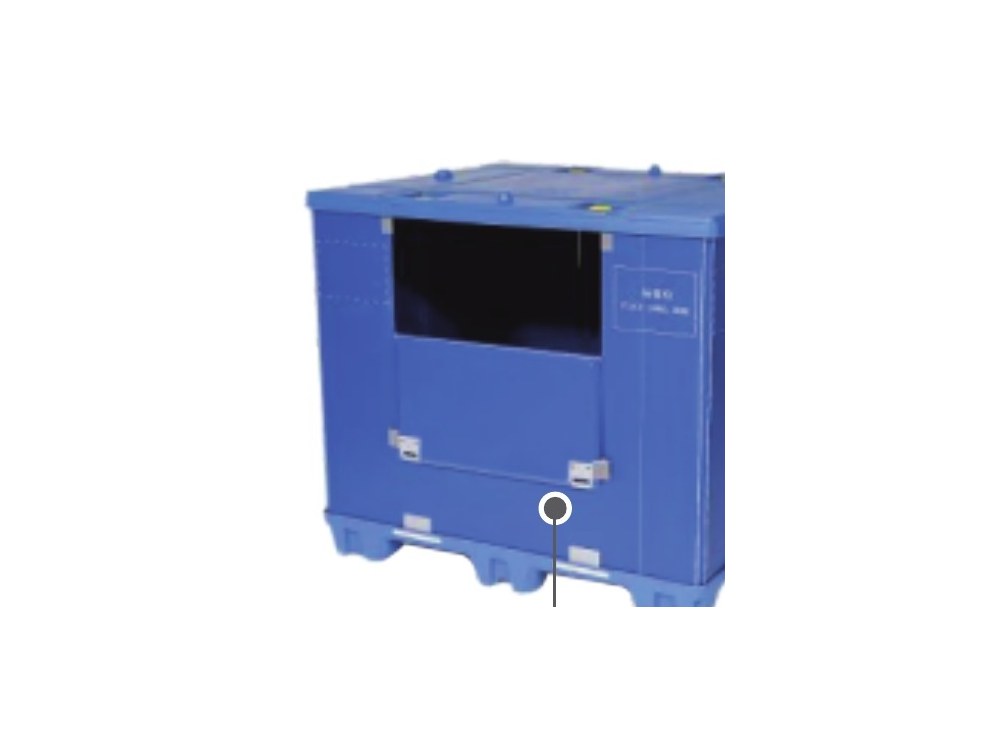
A collapsible sleeve pack can change empty-return space and handling in a component supply chain. Compare its actual assembled and collapsed dimensions, usable payload, dunnage and complete cycle cost with the current container. The return arrangement and fleet needed for the lane are part of the decision.
A proposed system may combine a pallet base, folding sleeve and lid. Confirm how each component is stored and returned, whether empty bases nest, and the complete empty stack's height, mass and stability. The folded sleeve thickness alone does not define the return volume.
Model the return trip and required fleet
Use dimensions and loading rules to calculate whole-container capacity. For a hypothetical height-only example, assume 2,400 mm usable height, 1,200 mm rigid-empty stacking pitch and 300 mm collapsed-empty pitch. The same floor position holds two rigid empties or eight collapsed empties: a 4:1 capacity comparison. This calculation assumes both stack arrangements are permitted; it does not establish a product's stacking rating.
If, additionally, there are an assumed 10 usable floor positions and a quoted return trailer price is assumed to be USD 400, capacity would be 20 rigid empties or 80 collapsed empties. At full utilization, the illustrative transport cost is USD 20 or USD 5 per empty. Actual loading must also satisfy vehicle geometry, weight, restraint and container stack limits, and actual utilization and quotes must replace these assumptions.
Collect these inputs for the actual lane:
- Completed deliveries by day or planning period, including peaks and any variation in the part mix.
- Return-trailer quotation, actual floor layout, empty stacking pitch, permissible stack and vehicle limits.
- Elapsed cycle time through dispatch, use, waiting, return, inspection and readiness for the next dispatch.
- Missing, damaged and retired units, with the measurement period and denominator, replacement time and reserve policy.
For an independent fleet-sizing example, assume a stable flow of 100 containers per calendar day and a complete four-calendar-day cycle. The base requirement is 100 × 4 = 400 containers. An assumed reserve of 10% of that base adds 40, for 440 in total. All inputs are illustrative. Validate peaks, downtime, location-specific availability and the definition of a completed cycle before ordering a real fleet.
Dimensions and weights worth checking
Request a controlled drawing and measurement record for the proposed construction. Check these fields on an assembled sample with the intended dunnage:
- External footprint and height: include lid, fittings and any projection that affects conveyors, floor layout or racking.
- Usable internal envelope: measure between dunnage, walls, lips and restraints, with the required handling clearance.
- Empty stacking pitch: measure the agreed return arrangement, including bases, sleeves and lids rather than one loose component.
- Complete tare mass: include base, lid, sleeve, dunnage, labels and fittings for the actual shipping configuration.
Do not infer usable space from the external pallet footprint. Check the part envelope, insertion and removal path, dunnage and clearances together. Record any feature that changes when the sleeve is assembled, loaded or folded.
Ask which reinforcement, joints and supports the quoted base uses and what evidence supports its ratings. Distinguish floor storage, stacked containers, forklift handling and racking duty. Test the complete configuration under the applicable support and load conditions; a reinforcement description alone is not a capacity rating.
Dunnage does the actual protecting
Design dunnage for the part's contact surfaces, supported mass, finish and loading method. Compare proposed dividers, trays or cradles on retention, cleanliness, serviceability and the protection required for the actual component.
Define allowed movement, contact and restraint according to the component and route, then qualify handling, vibration, shock and stacking as applicable. Inspect both the parts and dunnage after testing. There is no universal free-play limit, and vibration is not the only possible damage source.
Parts that need something else
Resolve these duties before selecting the container:
- Heavy or concentrated loads. Establish mass, centre of gravity, support points and handling. Compare qualified base and container designs, including another container type if the proposed sleeve pack cannot meet the duty.
- Cleanliness-sensitive parts. Specify contamination limits, sampling and cleaning, then test the actual materials, hinges, edges and dunnage after the handling cycle. Neither a folding nor a rigid enclosure is automatically qualified for a cleanroom requirement.
- One-way or cross-border delivery. Quote and document the actual return, local reuse or recovery arrangement, including relevant customs and tax requirements. Include handling, missing units and disposal or recovery costs in the comparison.
Run a lane-specific trial before expanding the fleet. Measure delivery and return time, loading utilization, part condition, cleaning, repairs and losses, then update the cost and fleet assumptions with those records.
Request a sleeve-pack logistics scope review. Send the part drawing and mass, usable-space requirement, load and handling conditions, daily flow, cycle time and proposed return layout. Include current container and transport quotations so the sample, fleet and cost calculations can be checked.