
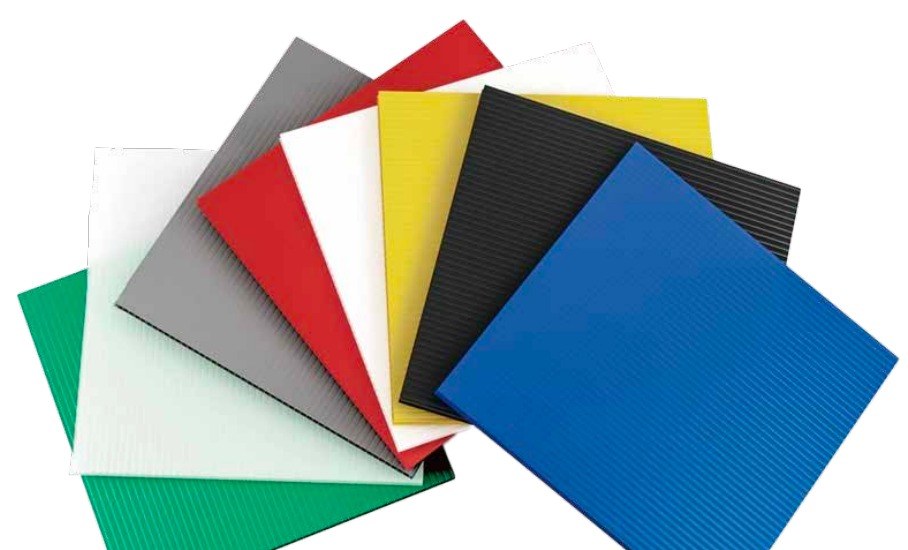
PP hollow sheet is an extruded polypropylene panel with two skins joined by internal ribs. Its geometry, resin formulation and fabrication affect its suitability for signs, dividers and reusable packaging. Compare the finished construction and intended duty, including joints and open edges.
Generic names include twinwall polypropylene, fluted polypropylene, PP corrugated board and PP hollow board. Confirm the resin, panel construction and specification when comparing quotations; the product name alone does not define a grade.
How it is made, and why that limits the shapes
The base panel is formed through an extrusion die, then sized, cooled and cut. Its skins and ribs are formed together. Added films, coatings, printed layers or joined components need their own checks; a one-piece extrusion does not make the completed product immune to cracking, separation or joint failure.
Flute direction influences bending and fabrication, so mark it on the cut layout and compare the required orientations under the actual support and load. Ask for the available extrusion widths, cut lengths and tolerances, including the constraints of any coating or printing process.
Thickness, weight and what actually determines stiffness
Thickness in millimetres and mass per area in grams per square metre describe different features. Also record resin grade, skin and rib construction where needed, dimensions, flute direction and the properties required for the finished part.
As a hypothetical comparison, two panels could both be 4 mm thick while one is specified at 500 g/m² and the other at 900 g/m². This illustrates why nominal thickness is insufficient; it does not establish available stock or either panel's load capacity. Compare samples and test results for the proposed constructions.
Organize the specification around four checks:
- Geometry and mass: thickness, dimensions, mass per area, rib direction and tolerances.
- Load and support: product contact points, unsupported spans, stack duration and permissible deformation.
- Fabrication: cutting, creasing, joining, printing and exposed-edge condition.
- Environment: temperature, chemicals, cleaning, sunlight and any electrical or flame-test requirements.
Compare thickness and mass together with geometry, grade, fabrication and test scope. A lower quotation may reflect a different construction or service scope; price alone does not identify the cause or establish that one panel performs better.
Ask for the available sheet sizes and the production and packing constraints of the actual line. For an assumed mass calculation only, a 1.2 m by 2.4 m panel has an area of 2.88 m². At an assumed 700 g/m² it weighs 2,016 g before any added fittings or packaging. Confirm dimensions and mass on delivered samples.
Grades that change the specification
Electrical properties. Define low-charging behaviour, the required resistance range and any discharge-shielding requirement with the ESD coordinator. Surface resistance in ohms and surface resistivity reported in ohms per square are different measurements. A material label or colour cannot replace the specified test report.
Ask whether the electrical system depends on a surface-active additive or a bulk formulation, and qualify the actual grade at the required humidity and temperature. For reuse, test after the agreed cleaning, abrasion and ageing procedure. The term permanent is not a guarantee that every finished panel retains its properties in every environment.
Flame performance. Request the report for the actual material, grade, colour, thickness and applicable test. UL explains UL 94 as small-scale material tests under controlled conditions. A V rating does not establish fire-code suitability or the fire performance of an entire sign, box or installation; check the intended end use separately.
Outdoor exposure. Request grade-specific evidence for the planned climate, colour, mounting and exposure period, with acceptance limits for appearance and retained mechanical properties. Stabilizers do not establish a universal service life. Laboratory exposure time needs an appropriate relationship to field performance, as discussed in ASTM G151.
Print preparation. Agree the ink, pretreatment or primer, cure process and storage conditions. Measure the required surface property using a method suitable for the panel, then confirm adhesion and readability on the printed, folded or cleaned sample. No single dyne target or elapsed time establishes every print system's suitability.
Temperature and chemical behaviour
Obtain the grade's qualified operating conditions and test the finished part at the intended minimum and maximum temperatures. Include time under load, impact, folding, cleaning and any change in properties after conditioning.
For cold-chain or winter handling, compare the proposed formulations with impact and fold tests at the specified temperature. The resin label alone does not prove that a fabricated box, crease or joint will survive the route.
For warm storage or transport, check the loaded assembly at the expected temperature and duration. Include the pallet support and joints. Agree permissible deformation and any operating restrictions from the test results.
Check compatibility with the actual substance, concentration, temperature, contact time and mechanical stress, including cleaners. Use grade-specific information and an agreed test where needed. A sheet or box with open flutes, seams or fittings must not be assumed to provide liquid containment.
Against the alternatives
Versus corrugated cardboard: compare the required moisture exposure and handling duty, followed by purchase, return, cleaning, repair and replacement costs. Qualify the complete package for the route. Neither a fixed reuse count nor a universal payback threshold follows from the material name.
Versus solid plastic sheet: compare stiffness, mass, surface condition, fabrication and total cost for the same duty. A hollow panel and a solid sheet distribute loads differently; test the required spans, contact points and joints rather than assuming one is always more efficient.
Versus injection-moulded crates: compare the actual crate and fabricated-panel designs on load, nesting or collapse, cleaning, repairs and handling. Obtain tooling and production quotations for the proposed designs. Manufacturing method alone does not determine service life or order economics.
Where it is the wrong material
Four situations, stated plainly.
Sustained compression. Qualify the load, support, temperature and duration together. A short compression result does not establish long-duration stack performance. ASTM D4577 provides a constant-load test framework; agree the method and acceptance limits with the packaging specialist.
Point loads and sharp edges. Inspect the contact footprint and edge condition. Use suitable load spreading, dunnage or another construction where the proposed panel fails the agreed puncture, deformation or handling criteria.
Hot filling, sterilization or other process exposure. Do not specify these duties from a general PP temperature range. Establish the complete temperature, duration, chemical and pressure cycle and require evidence for the actual grade and assembly.
Dimensional stability. State the allowable dimensions and flatness at the relevant temperatures and after storage or cleaning. Verify the fabricated part and its support; do not treat nominal room-temperature dimensions as proof of performance across the process.
Specifying it properly
A comparable quotation identifies dimensions and tolerances, thickness, mass per area, flute direction, grade, fabrication, quantity and packing. Add load and support, planned reuse, exposure, printing acceptance and any electrical or flame-test scope. Ask which assumptions the supplier has not yet verified.
Record the test specimen, conditioning, load path, procedure and acceptance limits. Confirm the result applies to the quoted construction, including joints, dunnage and contents where they affect the duty. The PP packaging specification guide walks through the load, support and quotation checks.
Discuss a PP hollow-sheet specification. Send dimensions, product mass and contact points, stack and support details, fabrication requirements and the intended environment. Include existing samples or quotations so the required tests and unresolved assumptions can be identified.