
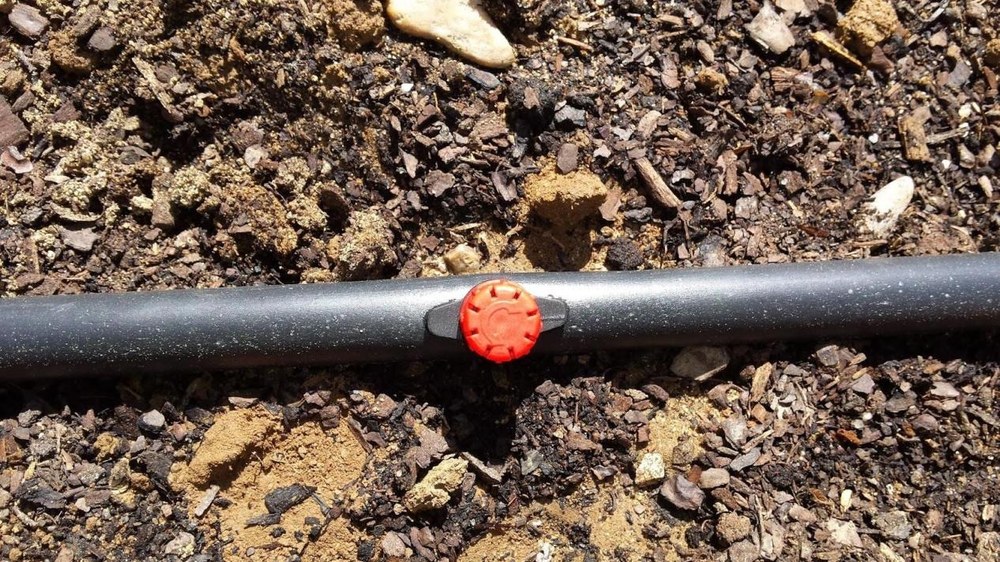
A drip system fails far more often from blocked emitters than from worn pipe. The emitter passages that make drip irrigation precise are fractions of a millimetre across, and sand, algae, organic matter or mineral precipitates close them one by one. The filter is the cheapest part of the system that decides how long all the others work.
How fine to filter
Filters are rated by mesh (openings per linear inch) or by the particle size they stop, in microns. A common rule of thumb in irrigation practice is to remove particles larger than about one-seventh to one-tenth of the smallest passage in the emitter, because particles smaller than the passage still clog it when they arrive together. In practice, emitter manufacturers state the filtration their product needs, and that figure takes priority.
| Mesh | Approximate opening | Typical use |
|---|---|---|
| 80 | about 180 microns | Coarse protection, sprinklers and larger emitters |
| 120 | about 125–130 microns | A common requirement for drip tape and drip line |
| 150 | about 100 microns | Emitters with fine passages |
| 200 | about 75 microns | Very fine emitters and micro-irrigation with small passages |
Matching the filter to the water
| Water source | Main problem | Usual filtration |
|---|---|---|
| Borehole or well | Sand and silt, sometimes iron | A sand separator (hydrocyclone) ahead of a screen or disc filter |
| River, canal, pond or reservoir | Algae, organic matter, suspended solids | Media filter, followed by a screen or disc filter as a safety stage |
| Municipal or treated water | Occasional particles, scale | Screen or disc filter |
- Screen filters are simple and economical and suit relatively clean water; they block quickly with organic matter.
- Disc filters trap particles in the depth of stacked grooved discs, hold more dirt before cleaning, and cope well with organic material and algae.
- Media filters, beds of graded sand or gravel, handle heavy loads of organic matter and suspended solids from open water and are backwashed to clean.
Sizing a filter
- Size for the system's peak flow, meaning all laterals that run at the same time, not the average.
- Choose a filter whose pressure loss at that flow, when clean, is modest; filters that are too small lose pressure the emitters need.
- Allow for the pressure the filter will lose as it fills before cleaning. The pressure at the inlet of the laterals must still reach the working pressure of the tape or line.
Where the filter sits in the head unit
The order of components at the head of the system matters as much as the filter itself. A typical layout, from the water source to the field:
- Pump and check valve
- Sand separator, where the water carries sand
- Fertiliser injection point, placed upstream of the main filter so that any precipitate is caught before it reaches the emitters
- Main filter, with pressure gauges on both sides
- Pressure regulator, to hold the inlet pressure within the rating of the tape or line
- Zone valves and sub-mains, with flush valves at the ends and air relief valves at high points
Where fertilisers or chemicals are injected into a supply that is also used for drinking water, backflow prevention is required by most water authorities.
A pressure budget example
Suppose drip tape rated for up to 1.0 bar needs about 0.8 bar at the start of each lateral. The regulator is set to deliver that. Upstream of it, the pump must cover the losses in the main line and fittings, the filter's loss when clean, typically a few tenths of a bar, and the extra loss the filter adds before it is cleaned. If the filter is cleaned when its loss has risen by 0.5 bar, the pump must have that margin in hand, or the far end of the field will be under-watered every time the filter is due for cleaning. Working the budget out at the design stage prevents the most common complaint about drip systems: uneven watering that nobody can trace.
When to clean
Install pressure gauges before and after the filter. The difference between them, the pressure drop, rises as the filter collects dirt. Record the pressure drop when the filter is clean and clean it when the drop has risen by a set amount; many growers use a rise of about 0.3–0.5 bar as the trigger. Automatic backflushing filters do this on their own, which is worth the cost on dirty water or large systems.
Beyond the filter
- Flush the laterals. Open the ends of the tape or line periodically, especially at the start of the season, to wash out the fine sediment that passes any filter.
- Watch the chemistry. Hard water deposits calcium carbonate, iron-rich water deposits iron oxides, and fertilisers can precipitate in the lines. Filters do not stop dissolved minerals; water treatment such as acid injection is used where precipitation blocks emitters, under proper guidance.
- Keep algae out of the light. Opaque pipes and black drip line resist algae growth inside the system.
Filtration and emitter choice belong together: see drip tape or drip line for choosing the lateral. When you send us an enquiry for drip tape or drip line, include the water source and a recent water analysis if you have one, and we will state the filtration each emitter needs.