
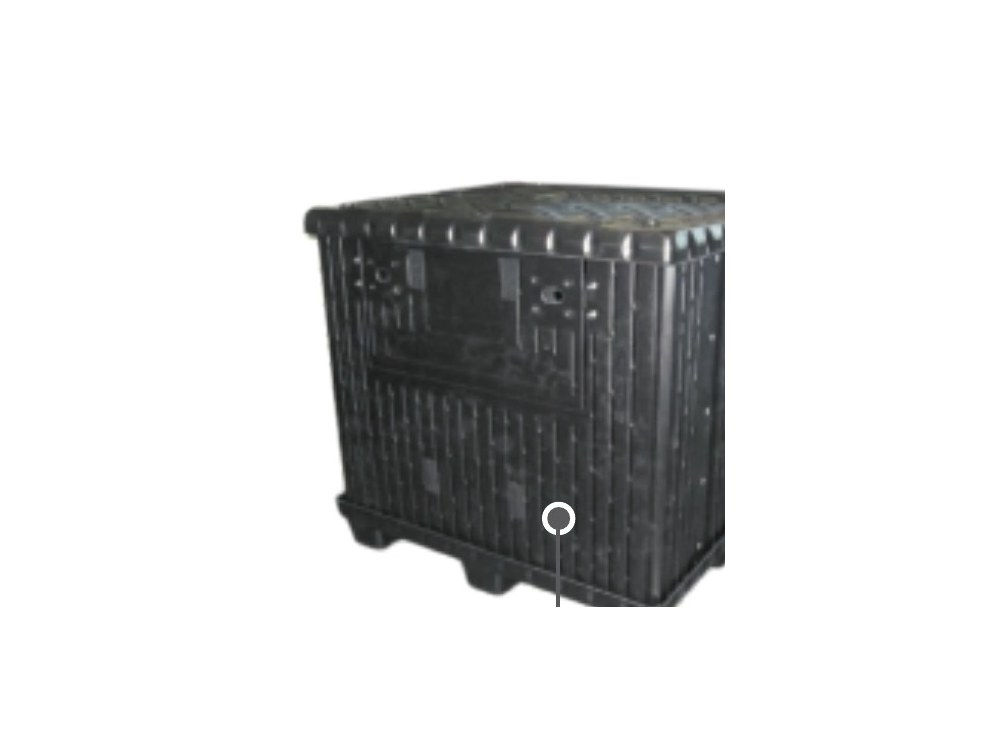
Compare sleeve packs as complete assemblies: pallet base, sleeve, lid, reinforcement, locks and dunnage. A manufacturing process or a photograph does not establish usable dimensions, load rating, impact resistance or life. Ask for the drawing and evidence for the exact proposed model.
Separate the moulding process from the base layout
Twin-sheet thermoforming, blow moulding and injection moulding describe manufacturing approaches. Nine feet, runners, reinforcement and fork-entry direction describe design features. An injection-moulded runner base is not a fourth moulding process, and the presence of runners alone does not make an assembly heavy duty.
| Construction or feature | What to clarify | What the name does not prove |
|---|---|---|
| Twin-sheet thermoformed | Formed skins, joint details, supports and reinforcement | The lowest price, mass or a particular stack load |
| Blow-moulded | Wall distribution, contact details and available model geometry | Superior impact resistance or a longer service life |
| Injection-moulded | Ribs, sections, material grade, tolerances and support layout | A solid section, a lower profile or automatic line compatibility |
| Feet or runners | Contact positions, openings, entry directions and reinforcement | Pallet-truck, conveyor or rack compatibility without a fit check |
Compare the same dimensions
Obtain external footprint, assembled height, usable internal length and width, clear usable height, base height, lid engagement and the actual sleeve drawing. State where dimensions are measured and how tolerances, tapers, ribs, locks and dunnage reduce the working space. A sleeve height, a rim height and an internal clearance must not be interchanged.
For a hypothetical dimensional check, suppose an assembly has an external footprint of 1,200 × 1,000 mm, clear internal dimensions of 1,140 × 940 mm and a clear usable height of 800 mm. Its rectangular internal envelope is 1.140 × 0.940 × 0.800 = 0.85728 m³. The external footprint area is 1.20 m² and the internal footprint area is 1.0716 m², 10.7% less. These assumed values are not a model specification, and the envelope is not proof of packed capacity: the actual part, dunnage and loading path must fit.
Check the largest part's insertion and removal as well as its final location. A part can fit inside the envelope but fail to pass the opening, locks or lifting equipment. Approve a representative loaded sample before setting the final tooling and quantity.
Check the handling and support duty
Send the forklift and pallet-truck geometry, entry directions, conveyor contact and any rack support. Include fork openings, roller spacing, runner contact and clearances. Feet or runners that look suitable in a photograph can still interfere with the equipment. Test the actual interface.
Distinguish floor stacking, handling while loaded and support on rack beams. Ask the supplier to state payload distribution, support positions, load duration, temperature, deflection limits, stack arrangement and failure criteria for each reported capacity. A static rating is not automatically a rack or handling rating.
ISO 8611-1:2025 provides test methods for new flat pallets, with stated scope exclusions for certain attached container structures. A pallet-base result does not by itself qualify the sleeve-pack assembly. Ask the test provider to confirm scope and the additional assembly and field tests required for the intended duty.
Measure the complete loaded and folded assembly
Weigh the base, lid, sleeve, reinforcement, locks and dunnage using the same included-parts list for each quotation. Do not compare one bare base with another reinforced assembly or assume a process guarantees the lightest finished pack.
Measure the actual folded return height and show how sleeves, lids and bases are retained and stacked. Calculate the return arrangement from those units, vehicle dimensions, restraints, payload and handling clearances. A folding ratio from nominal heights is not evidence of the same ratio in loaded return trips.
Qualify opening and closing, replacement parts, cleaning, inspection and repair in the intended loop. Record failure and retirement criteria. A thicker sleeve, steel tube or locking kit can change the load path; it does not prove a longer service life without the corresponding evidence.
Request a comparison quotation
Use one brief for all proposals: part and dunnage drawing, payload and its distribution, usable dimensions, handling equipment, floor and rack supports, stacking duration, environmental and cleaning conditions, return layout and acceptance tests. Ask each supplier to list the model, material, reinforcement, locks, tooling, included tests, sample cost, MOQ and delivery terms separately.
Request a sleeve-pack comparison with the loaded and folded layouts, order quantity and destination. Review sleeve packs in automotive parts logistics for return-loop and fleet-planning questions, and compare packaging materials for the proposed assembly.