
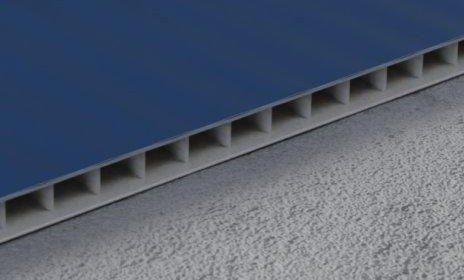
Polypropylene is chemically inert and has a low surface energy, which is exactly why it makes durable signs and boxes, and exactly why ink does not want to stick to it. Printing on PP hollow board that survives rain, handling and scratching depends less on the printer than on what happens to the board's surface before the ink arrives.
Why ink slides off untreated PP
A liquid only wets and bonds to a surface whose surface energy is higher than its own surface tension. Untreated polypropylene sits at roughly 29–31 mN/m (dynes per centimetre), below what most inks need. The ink beads, cures on top of the surface rather than bonding to it, and peels off with a fingernail or a piece of tape.
Corona treatment: raising the surface energy
Corona treatment passes the board through a high-voltage electrical discharge that oxidises the outermost layer of the plastic and raises its surface energy. For printing, board is commonly treated to about 38–42 mN/m or higher, depending on the ink and printing process. Three practical points follow:
- Treatment fades. The effect decays over weeks and months, faster in warm storage and faster in board containing slip or antistatic additives. Board treated at the factory months ago may no longer be printable.
- Treat the side you print. Specify one-side or two-side treatment on the order.
- Measure, do not assume. Dyne test pens or test inks give a quick reading on arrival and again just before printing; the recognised methods for polyolefin film and sheet are the wetting tension tests in ASTM D2578 and ISO 8296.
Flame treatment and plasma treatment achieve the same result by different means and are used where corona is impractical.
Printing methods compared
| Method | Best for | Notes |
|---|---|---|
| Screen printing | Solid colours, large runs of the same design, outdoor durability | Use inks formulated for polypropylene; a setup cost per colour |
| UV flatbed inkjet | Short runs, full-colour images, variable designs | UV-curable inks for plastics; some need a primer or adhesion promoter on PP |
| Flexographic printing | Very long runs of simple graphics | Economic only at high volumes |
| Printed labels or films | Photographic quality, small quantities | An extra layer that can peel at the edges outdoors |
Testing adhesion before the run ships
- Surface energy check with dyne pens on each batch of board before printing.
- Cross-hatch tape test on printed samples after full cure: cut a lattice through the ink, apply and remove pressure-sensitive tape, and rate how much ink lifts. ISO 2409 and ASTM D3359 describe the method and the rating scale.
- Scratch and rub checks with a fingernail and a damp cloth, repeated after 24 hours.
- Outdoor exposure for signs: ink colour fastness and the board's UV stabiliser both decide how long a sign looks right. See how long corrugated plastic signs last outdoors.
Printing boxes and folded parts
For boxes, sleeves and crates made from hollow board, print the flat sheet before it is cut and folded wherever the design allows. Printing is easier and more accurate on flat sheet, and the die can be registered to the print. Keep artwork clear of score lines and hinges, or use flexible inks there: rigid inks crack where the board folds. Leave unprinted areas where parts will be welded or stapled, because ink can weaken the joint.
Colour, proofs and approval
Colour on white polypropylene does not look the same as colour on paper. Approve a physical proof printed on the actual board with the actual ink, and specify colours against a physical colour sample or a named colour standard rather than a screen. The colour of the board itself varies slightly between production batches, which shifts light printed colours; for colour-critical work, order the board for the whole job in one batch.
Storing board before printing
- Keep treated board in its packaging, away from heat and direct sunlight, which accelerate the decay of the treatment.
- Handle it by the edges: skin oil on the print surface lowers wetting in exactly the places people touch.
- Use the oldest stock first, and retest the surface energy of anything that has been in storage for a long time before committing a print run to it.
Board details that affect the print
- Surface finish. A smooth, uniform skin without flow lines prints more evenly.
- Thickness and flute direction. Thin boards can show the flutes through large solid areas; for photographic prints on thin board, test first.
- Colour. White board gives the truest colours; printing light colours on coloured board needs a white underlayer.
- Static and dust. PP board attracts dust, which prints as specks. Clean or ionise the surface before printing.
What PP hollow board is and how its grades differ is covered in what is PP hollow sheet. When you order board for printing, tell us the printing method and whether you print one side or both, and we will supply advertising boards or PP hollow sheets with the treatment and surface to match.